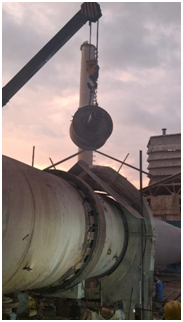
Engineering Solutions for Kiln Shell
We take pride in our expertise in rotary kiln diagnostics, condition assessment and preparation of comprehensive corrective action plans. The plan prepared for industry's most challenging kiln maintenance project, witnessed in last 35 years. Every corrective strategy is developed with meticulous planning and engineering precision to ensure optimum reliability and productivity.
During our detailed kiln inspection, following major deviations were identified:
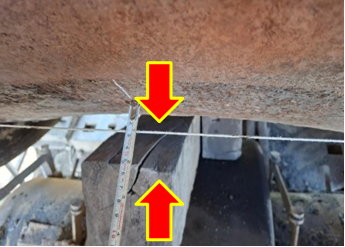
- Shell deformation beneath the tyre: Maximum shell depression of approximately 30 mm and minimum of 10 mm for nearly 270° of the kiln shell circumferences. The deformation is usually called as "Shell Constriction".
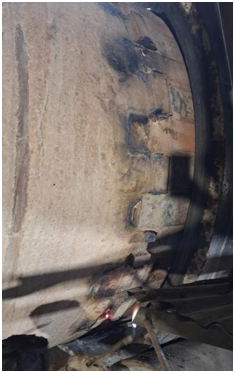
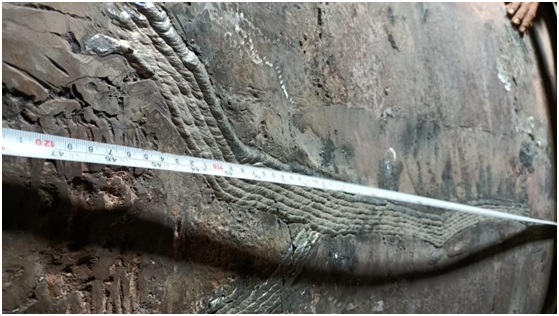
- Shell thickness under Tyre-1: Wear of up to 70 mm, accompanied by fuel pipe damage and multiple shell cracks. Radiographic inspection was carried out over the affected zone.
- Tyre Shell Crack: Visual inspection showed a total of 18 cracks ranging from 550 mm to 1100 mm in length on the kiln shell underneath the tyre. Five cracks measured 1100 mm and were found to be through cracks, while the remaining cracks extended to a depth of approximately 30–40 mm.
- Kiln Shell Runout: Significant shell runout was observed, affecting kiln stability.
- Support Roller Condition: Support rollers exhibited a concavity of approximately 15–16 mm.
- Tyre Side Face Condition: Tyre side face at retainer position observed taper wear to approximately 45 mm with approximately 45° angle.
- Tyre Migration: Shell-to-tyre migration of approximately 75 mm per revolution was observed.
The combined effect of the observed abnormalities resulted in frequent operational interruptions, reduced kiln availability, lower production efficiency, and an increased risk of catastrophic failure.
Allan Smith Engineering was entrusted with developing a technically sound and cost-effective corrective action plan within the client's budgetary constraints and the timeline. Our team of experts worked out in excess of one month coupled with the site visit, for detailed measurements, engineering analysis, technical evaluations, and extensive discussions with the client's operating and maintenance teams to freeze the action plan.
Based on the findings and the available resources, a comprehensive corrective action plan developed in close consultation with the end user. A detailed bar chart schedule was prepared, incorporating resource planning, activity sequencing, manpower allocation, equipment requirements, and execution timelines to ensure completion within the assigned duration of shutdown without compromising quality or safety.
Activites planned:
- Full Floating Chairpad installation.
- Correction of kiln shell constriction (underneath tyre shell) for installation of the chairpad.
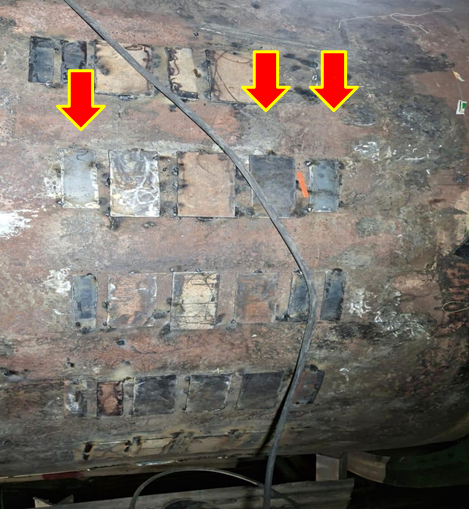
- Repair of cracks on the kiln shell, underneath the tyre.
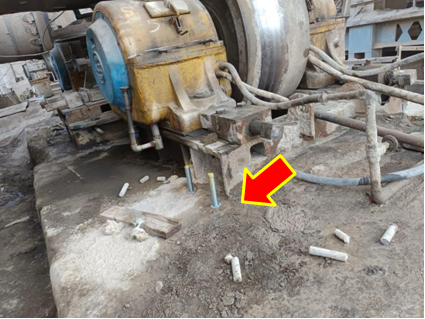
- Reinforcement of the base frame by installation of additional foundational bolt.
- Both Support rollers replacement.
- Checking and correction of blue matching of the journal bearings.
- Both guide rollers replacement.
- Alignment of pinion with respect to girth gear.
- Drive alignment.
The entire scope of work was successfully executed within the stipulated schedule. Upon completion, the kiln was restored to stable operation, achieving improved mechanical reliability, enhanced operational stability, increased equipment availability, and consistent production performance.